
Designer Statement, Fall 2025
#SpeculativeBureaucracy

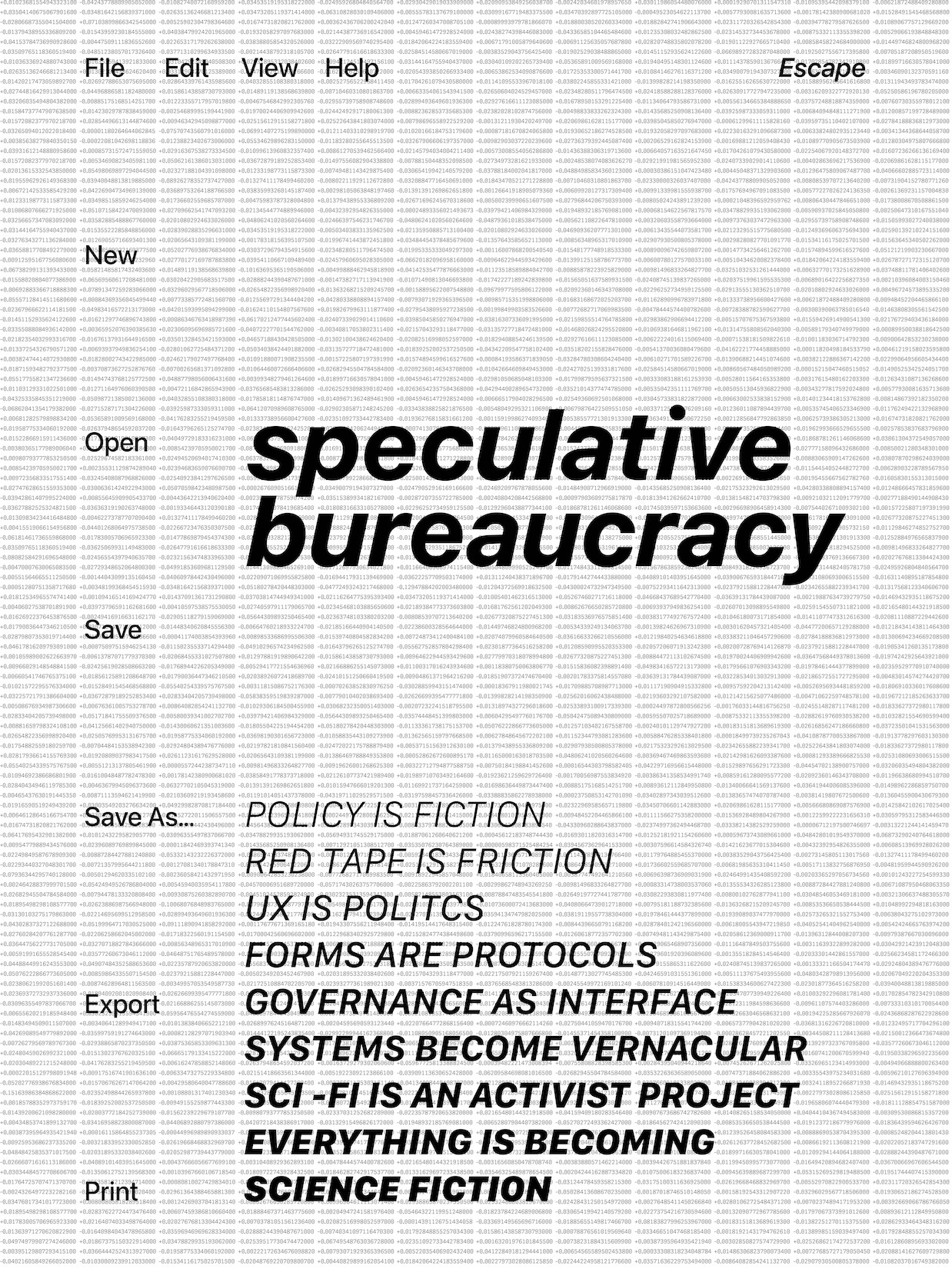
This is a brief essay written in response to being asked to think about my influences and what kind of design work I’m most interested in doing. I wrote it during my first term studying Speculative Design at UCSD.
“Everything is becoming science fiction.”
—J.G. Ballard, 1971
Speculative Bureaucracy
Something that many science-fiction authors who are celebrated for their prescience frequently have to disclaim is their supposed powers of prediction. William Gibson often remarks in interviews that sci-fi is more about sensing into the weirdness of the present than seeing the future. His early trilogy of novels was set a half-century ahead of when he was writing, his second trilogy was set closer to a dozen years out, then he wrote a series of novels set in the near-present or recent past. The speculative horizon grows shorter and shorter until it’s upon us.
I’m fascinated by the idea that you can do sci-fi about the present day. It’s often said that science fiction is where we work out the important issues of our time, the way the modern novel once did. Today the stuff of our lives is mediated by complex global information networks and impossibly sophisticated technologies. To deal with the contemporary is to deal with futurity, to speculate.
High Tech / Low Theory
Gibson’s early cyberpunk stories were a reaction to the optimism of an earlier age of science fiction that lauded rational progress and colonialist fantasy narratives. His characters were more akin to the kind of grimy criminals you might find in a noir detective novel, giving the genre a quality that Bruce Sterling described as combining “high tech” and “lowlife.” It was a world in which “the street finds its own uses for things,” where new technologies move from the prototype in the lab into the hands of hustlers and hackers who redeploy them for their own purposes.
Cultural theorist McKenzie Wark describes a similar practice in the realm of philosophy. In her work on the Situationist Internationale, she characterizes a kind of critical philosophy happening outside of the ivory tower in which artists and activists appropriate the “high theory” language of established intellectuals and apply it to their own everyday concerns. She calls this “low theory”—the work of moving critical philosophy out of the university and into the streets.
I’m drawn to this double movement—technology and theory both getting refashioned by those outside of the halls of power.
Design Friction vs Dark UX
In their 2025 book Exocapitalism: Economies with Absolutely No Limits, artists and theorists Marek Poliks and Roberto Alonso Trillo describe how platform economies insulate themselves from the messy physical world through the increasingly convoluted abstractions of high finance and business-to-business Software-as-a-Service sales models. They call this process “Lift.” The corollary is “Drag”—the attempts to slow capital’s takeoff by adding friction, creating impediments and frustrating smooth operations. They show how bureaucracies weaponize this concept through the administration of human-resources departments and social-assistance programs that employ red tape and complicated requirements to limit access and generate opportunities for value extraction.
Design has an opportunity to surface these operations. What began as the utilitarian and invisible practice of user experience—perhaps best exemplified by Apple’s Human Interface Guidelines—has taken on a more sinister dimension in the practice known as Dark UX: the deliberate manipulation of users into performing actions they didn’t intend, or the obstruction of actions they wish to take, such as canceling a subscription.
In a cultural moment defined by anxiety over the effects of always-on media streams and addictively sticky platforms, there is a growing call to slow things down, to design moments of pause and reflection. Friction can operate at many scales and be employed for pro-social benefit or for cynical profit. By invoking the raw materials of these interfaces—the layouts of bureaucratic forms, the progress indicators and menus of operating systems and web apps—I aim to make legible the otherwise obscure techniques that conceal the interests embedded within them.
Sci-Fi as Activist Practice
A question running through my areas of concern is: “who gets to make the future?” Visions of the future are never singular or inevitable. They’re contested and provisional, rooted in the outlook of their times and shaped by forces with the power to disseminate them. Cyberpunk reflected the geopolitics of the Cold War 1980s and fears of waning American dominance under globalization. Much of its aesthetics read as retro-futuristic today. The 1990s gave us the popular techno-optimism of WIRED magazine which Silicon Valley happily promoted. Alternative visions found in Afrofuturism and Indigenous Futurism offer suggestions of what other realities could look like if different values and priorities flourished.
As Walidah Imarisha observes in the introduction to Octavia’s Brood: Science Fiction Stories from Social Justice Movements, efforts to change the world for the better begin with a process of envisioning those worlds; she writes that “all organizing is science fiction.” This tells me that the corollary is also true: science fiction is a kind of activism, attempting to influence reality by telling stories about potential futures. We can critique futuring the same way we critique any institution—whose futures get funded, whose are foreclosed, who benefits from the visions being sold.
Vernacular Futures
I’m interested in the contact points where the infrastructure of technologies and institutions meets the lived experiences of the people they affect, and the vernacular forms of remixing and reinterpretation that happen there. The texture of our modern lives is shaped by user-interface elements and the global pop iconography of emoji. We communicate in a shorthand of recombinant media circulating in our feeds and timelines. Images that carry sociological significance are repurposed and recontextualized as memes like a Duchamp Readymade. Like graffiti on public signage, UI becomes a landscape for subversion.
My practice operates in a space I’m calling Speculative Bureaucracy—using the visual languages of administration and policy to open up a space for criticism of the systems we experience every day. This is low theory applied to interface design, finding new uses for the everyday aesthetics of control in an effort to imagine different futures.
-it’s ya boi